


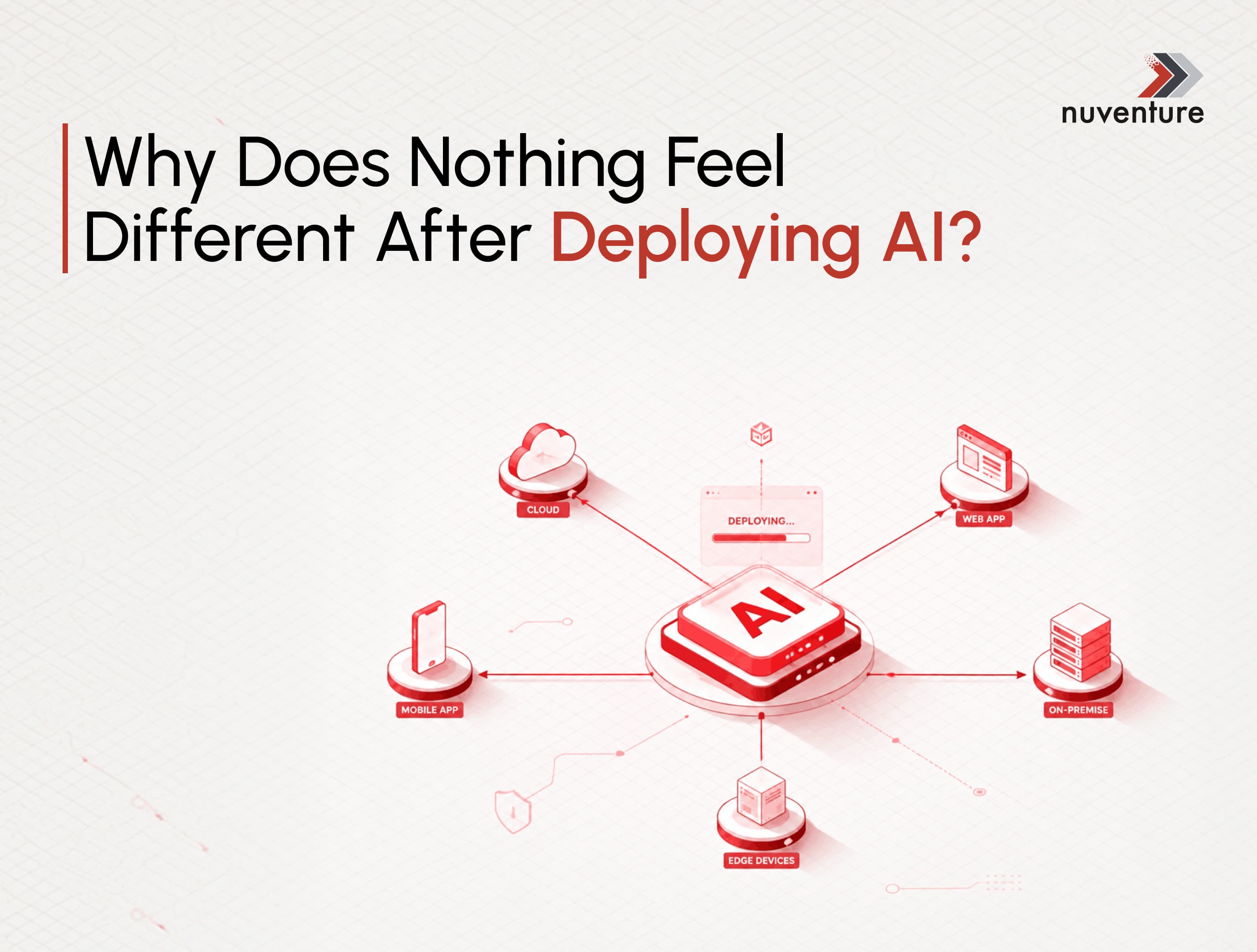
Your company has invested in AI. There’s a tool for your sales team, a dashboard for operations, maybe a chatbot handling customer queries. Leadership is satisfied. The slide deck shows deployment numbers. And yet, six months in, nothing has fundamentally changed about how the business runs.
You are not alone. And this is not a technology problem.
The AI Adoption Trap
Here is what the data actually says: as of 2024, 78% of organizations globally were using AI in at least one business function, a number that had nearly doubled from 55% just a year prior. Adoption, by any measure, is no longer a differentiator. It is table stakes.
But here is the number nobody puts in the investor update: only 21% of those organizations had fundamentally redesigned even a single workflow around AI. The rest had simply placed new technology on top of old processes and expected different results.
This is the adoption trap. It looks like progress. It costs like transformation. But it delivers neither.
The distinction matters enormously. When AI is dropped into an existing workflow without changing how decisions are made, who owns outcomes, or how information flows, it does exactly one thing: it speeds up the old way of working. Faster reports based on the same flawed data. Faster approvals moving through the same broken chain. Faster outputs of a process that was never designed for intelligence.
That is not transformation. That is acceleration of the status quo.
What Research Actually Tells Us About AI Adoption
Two decades ago, economists Erik Brynjolfsson, Daniel Rock, and Chad Syverson identified what they called the Productivity J-Curve, a pattern that repeats itself every time a major technology enters the enterprise. Productivity initially dips or stalls. Then, after organizations invest in the harder, slower work of restructuring workflows, retraining people, and rebuilding processes, gains eventually materialize, often dramatically.
Their research, published through the National Bureau of Economic Research, argued that the value of general-purpose technologies like AI is not in the technology itself, but in the complementary organizational investments that follow. Firms that combined technology with decentralized decision-making, for instance, experienced productivity gains three to five times larger than those that invested in technology alone.
This finding has only grown more relevant. A 2025 paper in the California Management Review reinforced the same principle for the AI era: “Sustainable AI transformation is less about algorithms and more about organizations.” The researchers found that the critical enabler of AI value is not technical capability, but the intersection of organizational design and human-AI collaboration, how work is restructured, how accountability is assigned, and how the business chooses to measure what matters.
In other words, the technology is the easy part. The organization is the hard part. And most enterprises have only done the easy part.
The Three Places Transformation Actually Stalls
Understanding where the gap lives helps you close it. There are three consistent failure points.
The first is workflow preservation. Most AI implementations are designed around existing processes, not in spite of them. A demand forecasting model is built to fit inside the same Excel-driven planning cycle that existed before. A predictive maintenance system sends alerts to the same inbox that used to receive manual reports. The AI adapts to the organization, rather than the organization adapting around the AI. The result is that the technology underperforms, not because it is weak, but because it has been constrained by the architecture it was inserted into.
The second is accountability ambiguity. When AI generates a recommendation and a human overrides it without explanation, and that decision turns out to be wrong, who owns it? When neither the system nor the person is clearly accountable, AI-assisted decisions get made the same way as AI-free ones, by whoever is loudest, most senior, or most risk-averse. Without redesigned decision rights, AI adds data to the room without changing the quality of what comes out of it.
The third is measurement inertia. Organizations measure what they have always measured. If your KPIs were built for a pre-AI operating model, they will not capture the value AI is generating, and they will not expose the value it is failing to generate. Revenue growth through AI, according to Deloitte’s 2026 State of AI report, remains an aspiration for 74% of enterprises. Only 20% are actually achieving it. The measurement gap is part of why.
What Transformation Looks Like in Practice
A mid-sized seasonal home goods manufacturer in Ohio faced a version of this challenge. Demand swings of 400% between July and December were being managed with manual forecasting for 180 SKUs, a process that consumed 45 hours of planning time each week and still produced forecast accuracy of only 42%. The result was $2.3 million in annual inventory costs from seasonal overstock and a 23% stockout rate during the peak quarter.
The problem was not a lack of data. The manufacturer had years of sales history, supplier relationships, and production schedules. The problem was that none of it was connected, and none of it was being used intelligently.
Nuventure built a predictive analytics engine that processed over 60 variables simultaneously, weather patterns, retail promotion calendars, injection molding cycle performance, and three years of seasonal sales data. Critically, the solution did not just add AI to the existing process. It replaced the forecasting process itself. Procurement became automated, maintenance became predictive, and the planning cycle that once took 45 hours was compressed to 8.
The outcomes were not incremental. Forecast accuracy moved from 42% to 89%. Stockouts dropped by 71%. Inventory costs fell by 37%, eliminating $850,000 in post-holiday markdowns. Production uptime improved by 28% because equipment failures were anticipated rather than reacted to. Profit margins increased by 22%.
None of that came from the AI alone. It came from a willingness to redesign the operating model around what the AI made possible.
The Question Worth Asking Right Now
If you have deployed AI and are not seeing transformation, the question is not whether you bought the right model or chose the right vendor. The question is whether your organization has done the structural work that turns a technology investment into a business outcome.
That means asking: Have we redesigned the workflows AI now sits inside, or did we fit AI into workflows built for a different era? Have we changed how decisions get made, or are we still making them the same way with better-looking data? Are we measuring the right things, or are we reporting on the technology rather than the result?
Where This Goes from Here
The enterprises that will be defined by AI are not the ones that deployed it earliest. They are the ones that rebuilt around it most completely. That is a harder conversation to have internally, and a harder engagement to execute. But it is the only path from adoption to transformation.
If your organization is ready to have that conversation, not about AI tools, but about AI outcome, Nuventure Connect has spent 16 years doing exactly that work, across manufacturing, logistics, pharmaceutical, and enterprise technology clients. The starting point is always a clear-eyed look at where intelligence is actually missing in your operations. That conversation is worth having before the next budget cycle closes. Talk to our AI experts today.